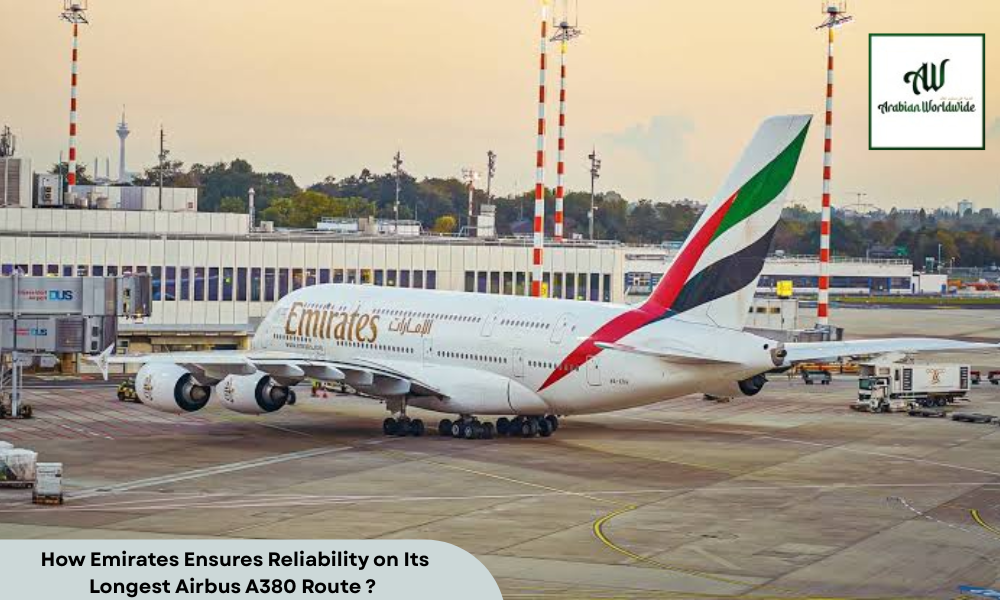
Operating the world’s longest Airbus A380 route requires far more than deploying the airline’s largest aircraft. Emirates’ nonstop service between Dubai International Airport (DXB) and Auckland Airport (AKL) is a carefully orchestrated operation that balances aircraft performance, fuel planning, weather conditions, and operational flexibility to ensure one of the aviation industry’s most demanding flights runs smoothly.
While the route is widely recognized for its exceptional duration, the airline’s behind-the-scenes contingency planning plays an equally important role in maintaining reliability.
Strategic Backup Beyond the Nonstop Flight
Since inaugurating the Dubai–Auckland service in 2016, Emirates has quietly strengthened the route with an alternative travel network through Australia. Rather than relying solely on the ultra-long-haul nonstop service, the carrier has retained one-stop connections that allow passengers to reach New Zealand when operational requirements or market conditions make schedule adjustments necessary.
This dual-network approach provides the airline with greater flexibility, enabling it to adapt to changing weather patterns, aircraft availability, and fluctuating demand while minimizing disruption for travelers.
A Record-Setting Airbus A380 Mission
Spanning approximately 8,800 miles (14,162 kilometers), the Dubai–Auckland route remains Emirates’ longest scheduled Airbus A380 service and ranks among the longest commercial flights in the world. Since its launch in March 2016, it has showcased the airline’s ability to operate ultra-long-haul routes using the iconic double-decker aircraft.
However, the journey is far from routine. The westbound flight from Dubai to Auckland is particularly demanding due to persistent headwinds over the Indian Ocean and Southeast Asia. While favorable weather can reduce flight times to just over 17 hours, stronger winds frequently extend the journey to around 17 hours and 25 minutes, requiring meticulous planning before every departure.
Precision Planning Behind Every Departure
Ultra-long-haul operations leave little room for error. Emirates’ flight planners continuously evaluate seasonal wind patterns, fuel requirements, weather forecasts, and potential route adjustments to ensure safe and efficient operations. Even minor deviations can significantly increase fuel consumption and operational complexity over flights lasting more than 17 hours.
Despite these challenges, It continues to operate the route exclusively with the Airbus A380. The aircraft’s long-range capability, combined with its high passenger capacity across premium and economy cabins, makes it uniquely suited to one of commercial aviation’s most demanding and prestigious nonstop services.
Also Read :- How Emirates Is Investing $2 Billion to Counter Riyadh Air’s Premium Aviation Ambitions?