By the 1940s, nearly a decade after oil was first discovered in Saudi Arabia, Safaniyah Aramco had established a strong presence as an onshore operator across the Kingdom’s Eastern Province. Years of exploration, production, and geological studies had provided the company with a detailed understanding of the region’s subsurface formations, giving its exploration teams increasing confidence in identifying promising hydrocarbon reserves.
As geological research progressed, evidence suggested that these oil-bearing formations extended beneath the waters of the Arabian Gulf. This realization marked the beginning of Aramco’s offshore exploration ambitions. Building on insights gathered from onshore operations, geophysicist Dick Kerr began surveying the shallow waters along Saudi Arabia’s northern Gulf coast during the late 1930s. Drawing on aerial surveys and seismographic studies, Kerr identified an offshore structure with significant potential.
In 1939, he documented the location by marking a map with a red arrow and the note, “Possible high area offshore.” Though no immediate drilling plans followed, the observation remained part of the company’s geological records and would later prove pivotal.
Building the Foundation for Offshore Exploration
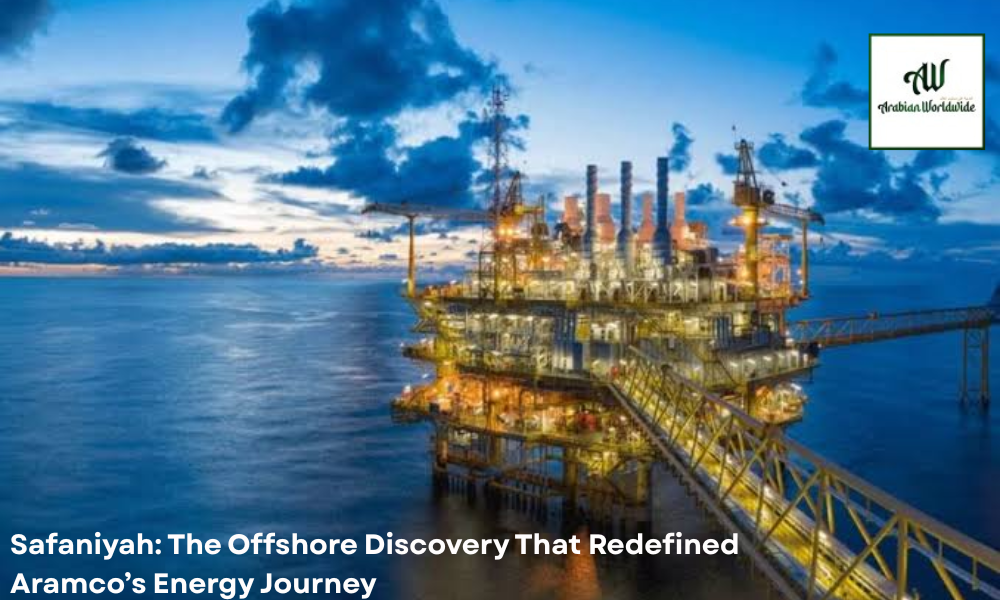
By 1950, accumulating geological evidence pointed to Safaniyah as a compelling candidate for offshore drilling. Aramco responded by constructing its first offshore drilling platform approximately three kilometres from the coast and around 225 kilometres north of Dhahran, in waters averaging 22 metres deep.
The early development relied on fixed-platform drilling systems, where steel piles were driven into the seabed to support the platform. Drilling rigs and derricks were installed for each well and removed once operations concluded, making the process both labour-intensive and expensive.
Although the relatively shallow waters reduced some technical complexities, offshore operations introduced an entirely new set of challenges. Equipment had to be transported by sea, platforms assembled offshore, and drilling crews adapted from desert conditions to confined marine environments. These operations also demanded tighter coordination between drilling teams and marine support personnel, along with more agile logistical planning.
Safaniyah No. 1 Opens a New Chapter
Despite these operational hurdles, exploration at Safaniyah advanced steadily. Guided by data gathered from onshore and coastal surveys, Aramco drilled its first offshore wildcat well Safaniyah No. 1 (SFNY-1) to determine whether reliable offshore drilling could be achieved using the technology and resources available at the time.
After more than 200 days of drilling, the well was successfully completed on August 15, 1951. With offshore pipeline infrastructure yet to be developed, crude oil was transferred directly into a barge positioned several hundred yards from the platform
.
The successful completion of SFNY-1 not only confirmed the presence of hydrocarbons beneath the Arabian Gulf but also demonstrated that offshore drilling could be carried out safely and effectively. The achievement marked Aramco’s first major step offshore, laying the groundwork for what is widely regarded as the world’s largest conventional offshore oil field and establishing the operational expertise that would shape the company’s future offshore developments.
Also Read :- How Emirates Is Investing $2 Billion to Counter Riyadh Air’s Premium Aviation Ambitions?