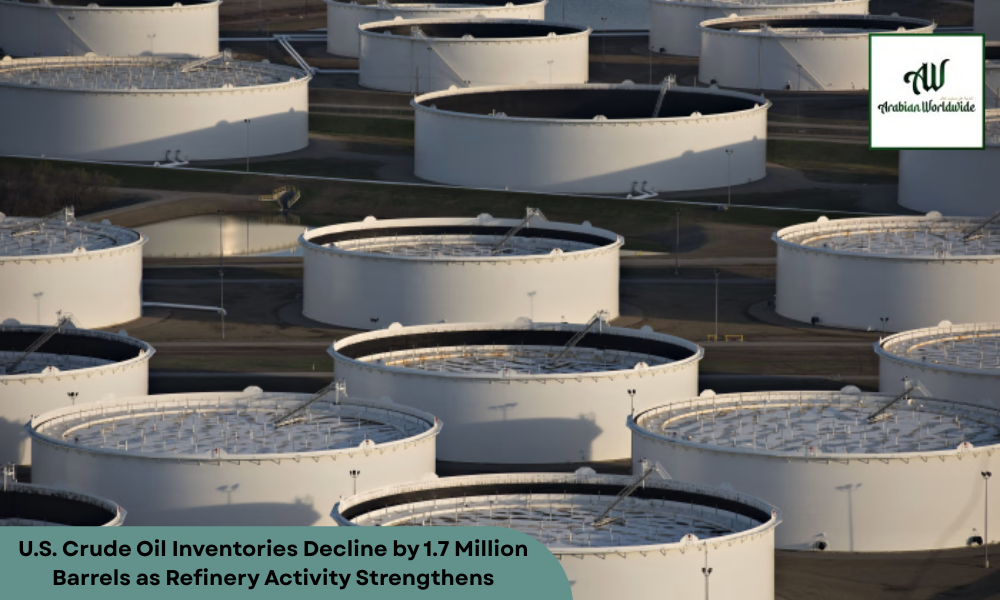
The U.S. Energy Information Administration (EIA) has reported a decline of 1.7 million barrels in the country’s commercial crude oil inventories for the week ending July 10, 2026, reflecting steady refinery demand and ongoing shifts in petroleum supply dynamics. Excluding the Strategic Petroleum Reserve (SPR), total commercial crude oil stocks stood at 409.7 million barrels, placing inventories 6% below the five-year seasonal average.
Refinery Operations Remain Robust
U.S. refineries continued to operate at a high level during the reporting week, processing an average of 17.1 million barrels of crude oil per day—an increase of 99,000 barrels per day compared to the previous week. Refinery utilization reached 96.2% of operable capacity, indicating strong operational efficiency amid consistent fuel demand.
While gasoline production edged lower to an average of 9.6 million barrels per day, distillate fuel production rose to 5.3 million barrels per day, reflecting a shift in refining output to meet evolving market requirements.
commercial crude oil Imports Rise Marginally
Crude oil imports into the United States averaged 5.7 million barrels per day, marking an increase of 60,000 barrels per day from the previous week. However, the broader trend remains lower, with average imports over the past four weeks standing at 5.5 million barrels per day, representing a 12.2% decline compared to the corresponding period last year.
Meanwhile, motor gasoline imports, including finished gasoline and blending components, averaged 354,000 barrels per day, while distillate fuel imports stood at 93,000 barrels per day.
Mixed Trends Across Petroleum Inventories
Petroleum product inventories presented a mixed picture during the week. Motor gasoline and commercial crude oil inventories declined by 1.5 million barrels, leaving stocks approximately 8% below the five-year average for this time of year. Both finished gasoline inventories and blending component stocks recorded decreases.
In contrast, distillate fuel inventories increased by 4.6 million barrels, although they remain 11% below the seasonal five-year average. Propane and propylene inventories also posted a significant gain, rising by 3.0 million barrels and standing 28% above the five-year average.
Overall, total commercial petroleum inventories increased by 13.3 million barrels during the week, highlighting continued stock accumulation across refined petroleum products despite the drawdown in crude oil reserves.
Fuel Demand Holds Steady
Demand indicators remained relatively stable over the past four weeks. Total petroleum products supplied averaged 20.3 million barrels per day, representing a modest 0.3% increase compared to the same period last year.
Motor gasoline supplied averaged 8.9 million barrels per day, down 1.1% year over year, while distillate fuel demand averaged 3.7 million barrels per day, reflecting a 2.1% decline. In contrast, jet fuel demand continued to strengthen, rising 2.3% from the corresponding period in 2025, signalling sustained growth in air travel activity.
Also Read :- DP World Eyes New UAE East Coast Port to Reduce Reliance on Strait of Hormuz