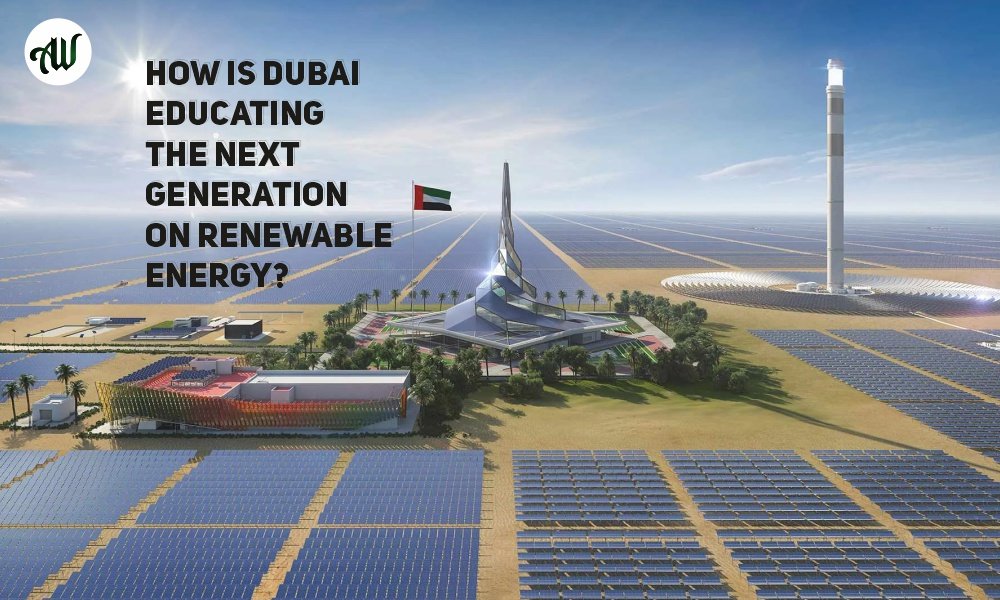
By 2050, Dubai aims to be a 100% clean energy nation. To achieve that, it is heavily educating its youth to adopt environmentally friendly measures in terms of daily operations. The vision will lead to a commitment to a sustainable outlook and make the region surge in its global image. The UAE Net Zero by 2050 Strategy, the Dubai Clean Energy Strategy 2050, and the Dubai Net Zero Carbon Emissions Strategy 2050 are all initiatives to position the region as a flagbearer of economic transformation.
Accommodating Renewable Energy in School Curricula
At the school level, Dubai has made sustainability a core learning outcome rather than an extracurricular subject. Environmental science classes increasingly include case studies on solar and wind power, while eco-clubs give students the chance to practice conservation and design small-scale renewable solutions.
The Dubai Electricity and Water Authority (DEWA) has taken an active role by partnering with schools to launch interactive programs like the Conservation Award. Students compete to propose energy-saving projects or awareness campaigns, which are then implemented in their communities. These hands-on experiences ensure that young learners see renewable energy not as a distant concept but as something that directly influences their lives and environment.
Higher Education and Research Opportunities
Dubai’s universities are equally aligned with the clean energy agenda. Specialized courses in engineering, environmental sciences, and business management now feature modules dedicated to clean energy systems and policies.
For instance, the Mohammed bin Rashid Al Maktoum Solar Park’s Innovation Centre acts as both a research hub and a training platform for university students. Here, young researchers experiment with solar technologies, energy storage solutions, and grid integration methods, gaining exposure to real-world challenges. Global universities with campuses in Dubai, such as Heriot-Watt and the University of Birmingham, integrate sustainability topics into mainstream curricula, ensuring that graduates across disciplines understand the business and technical dimensions of clean energy.
This approach not only produces skilled engineers but also business leaders, policymakers, and entrepreneurs who view renewable energy as central to economic and social development.
Government and Industry Training Initiatives
Beyond formal education, government agencies are creating bridges between academia and industry. DEWA’s Innovation Centre regularly hosts training sessions, hackathons, and workshops for young professionals and school groups. These activities allow participants to interact with cutting-edge technologies like smart grids, artificial intelligence, and green hydrogen applications.
The Dubai Future Foundation has also launched programs that prepare youth for “green jobs of the future,” blending entrepreneurship with technical learning. By exposing students to startup ecosystems, investment networks, and sustainability mentors, these programs empower young people to turn renewable energy ideas into scalable ventures.
Community Engagement and Public Awareness
Dubai’s education strategy is not limited to classrooms and research labs; it extends into the wider community. Developments like Sustainable City host tours where schoolchildren and families experience life in communities powered by solar energy. Festivals, exhibitions, and digital apps further spread awareness by gamifying energy-saving habits and showcasing the benefits of renewables.
The involvement of organizations such as the Emirates Youth Council ensures that young people are not just learners but also decision-makers. By including youth voices in sustainability policies and programs, Dubai cultivates a culture of ownership, where green energy is seen as a collective responsibility.
Linking Education to Employment
What makes Dubai’s approach especially effective is its ability to link education with career opportunities. Internship programs with multinational energy firms, graduate placements in government projects, and entrepreneurship incubators create clear pathways from classroom learning to professional practice.
This alignment means that students who study renewable energy do not just graduate with theoretical knowledge; they enter the workforce with practical skills, industry exposure, and a clear understanding of their role in the UAE’s green economy. For Emirati youth in particular, this represents a chance to contribute to national goals while building globally competitive careers.
Challenges and Future Outlook
Despite these achievements, challenges remain. Curricula must constantly evolve to include emerging technologies such as smart grids, energy blockchain, and carbon capture. Ensuring equitable access to high-quality renewable education across both public and private institutions is also a priority.
Yet these challenges are opportunities in disguise. By continuously updating its programs and fostering global partnerships, Dubai can position itself as not only a leader in renewable energy deployment but also in education and knowledge transfer. This would allow the emirate to export expertise as well as energy, shaping the sustainability agenda across the region.
Conclusion
Dubai’s commitment to renewable energy is not confined to large-scale projects or international pledges; it is deeply rooted in how the city educates its people. By weaving sustainability into school curricula, empowering universities to conduct advanced research, involving government agencies in training, and linking learning to real careers, Dubai is cultivating a generation that will carry the clean energy movement forward.
In doing so, the emirate demonstrates that clean energy education is not simply about science or technology; it is about shaping values, creating opportunities, and building resilience for the future. For a city known for setting global benchmarks, this focus on human capital may well be its most powerful contribution to the sustainability movement.