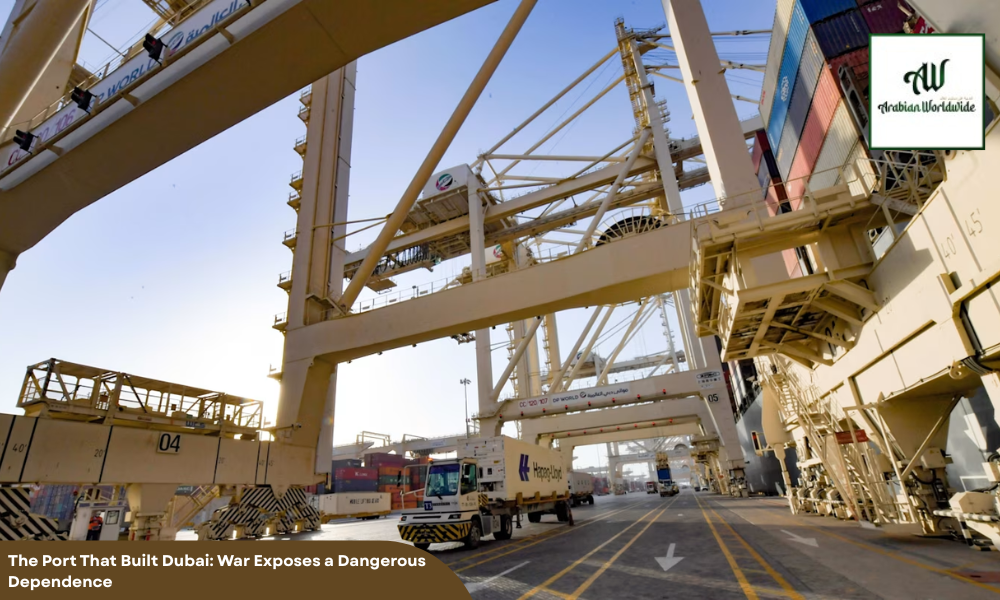
For more than four decades, Jebel Ali has been at the heart of Dubai’s transformation from a regional trading outpost into a global commercial powerhouse. Today, however, the conflict between the US, Israel and Iran has highlighted a vulnerability at the centre of that success: Dubai’s heavy dependence on a single strategic maritime gateway.
Severe disruption in the Strait of Hormuz has threatened shipping through the Gulf, placing pressure on operations at Jebel Ali. For an economy built around the seamless movement of goods, capital and people, prolonged instability could pose a serious economic risk.
Jebel Ali From Bold Vision to Economic Engine
The origins of Jebel Ali date back to Dubai’s long-standing role as a trading and communications link between India and Britain. Sheikh Rashid bin Saeed Al Maktoum, Dubai’s ruler during the 1970s and 1980s, championed the construction of the vast port despite criticism that it was excessively ambitious for a city whose existing port was underused.
That gamble ultimately transformed Dubai’s economic trajectory.
A pivotal development came in 1985 with the launch of the Jebel Ali Free Zone. The initiative allowed companies to import components, manufacture or assemble products and re-export them with fewer customs restrictions. Today, the zone hosts around 12,000 companies.
Together with the port and Dubai’s wider logistics infrastructure, it helped create a diversified, non-oil economy. The nearby Al Maktoum airport is also undergoing a $35 billion expansion designed to make it the world’s largest passenger and cargo airport.
A Hub With Global Stakes
The port and free zone now contribute more than a fifth of Dubai’s GDP. Jebel Ali also generated roughly 30 per cent of DP World’s revenues last year, underscoring its importance to one of Dubai’s most prominent corporate groups.
Its strategic value has attracted major international investors. Canada’s Caisse de dépôt et placement du Québec invested $5 billion in 2022 for a 22 per cent stake in a joint venture involving Jebel Ali and other Dubai assets, while Saudi Arabia’s Hassana later invested $2.4 billion for a 10 per cent stake.
Before the conflict, Jebel Ali’s four container terminals, equipped with more than 110 cranes, handled approximately 40,000 twenty-foot-equivalent units a day, making it by far the Middle East’s largest shipping hub.
The current disruption therefore represents more than a logistical challenge. It is a reminder that the infrastructure that powered Dubai’s extraordinary rise may also be its greatest strategic vulnerability.
Also Read :- Dubai Luxury Villa Renovations Surge as Owners Invest Millions in High-End Upgrades