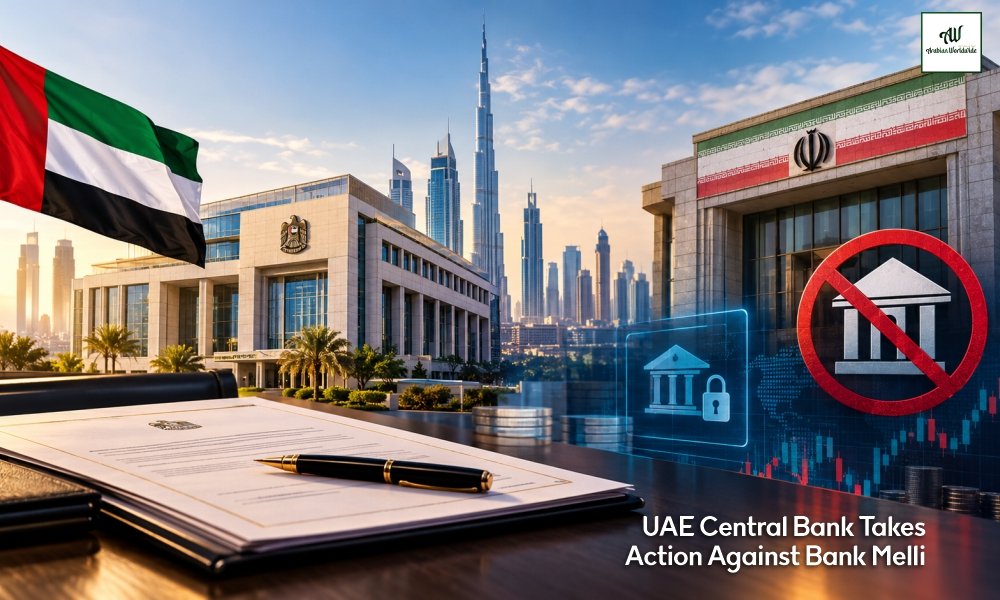
The United Arab Emirates’ central bank has barred Iran’s Bank Melli from conducting financial operations in the country, citing violations of regulatory requirements. The decision, announced on Wednesday, comes as relations between the UAE and Iran have deteriorated amid the ongoing conflict involving Iran and the United States.
According to the UAE central bank, all branches of Bank Melli in the country will be prohibited from carrying out financial transactions involving Iran. The restrictions cover activities including trade finance and transfers of funds between the UAE and Iran.
The regulator said the action followed breaches involving compliance with the UAE’s laws, regulations, and supervisory decisions. It specifically pointed to failures related to requirements designed to prevent money laundering, terrorist financing, and proliferation financing.
Action Follows US Sanctions
The UAE has traditionally served as an important economic and commercial link between Iran and international markets. Banks in Dubai have also maintained significant Iran-related deposits, although many of those funds have been frozen or restricted under US sanctions.
The latest move follows additional US action against entities connected to Bank Melli. In late August, the US Treasury’s Office of Foreign Assets Control sanctioned the manager of Bank Melli’s UAE branch, as well as a Hong Kong-based entity that US authorities said had assisted in laundering money for an Iranian exchange house already under sanctions.
It remains unclear whether the UAE’s decision represents a wider tightening of financial restrictions on Iranian institutions operating in the country. The US Treasury and Bank Melli had not immediately responded to requests for comment.
Longstanding Presence in the UAE Central Bank
Bank Melli has maintained operations in the UAE since 1969 and has seven branches spread across several emirates. Its main office is located in Dubai, according to information published on the bank’s website.
The UAE Central Bank also has a sizeable Iranian business and expatriate community, with many Iranian-owned businesses concentrated around Dubai Creek, a longstanding center of regional trade.
The financial restrictions could have broader implications given the importance of the UAE Central Bank to Iran’s trade network. World Trade Organization data shows that the UAE accounted for roughly 30% of Iran’s imports in 2024, worth approximately $21 billion, making the Gulf state one of Iran’s largest trading partners.
The suspension therefore adds another layer of pressure to an already strained economic relationship between the two countries.
Also Read :- Saudi Arabia Condemns Attempted Attack