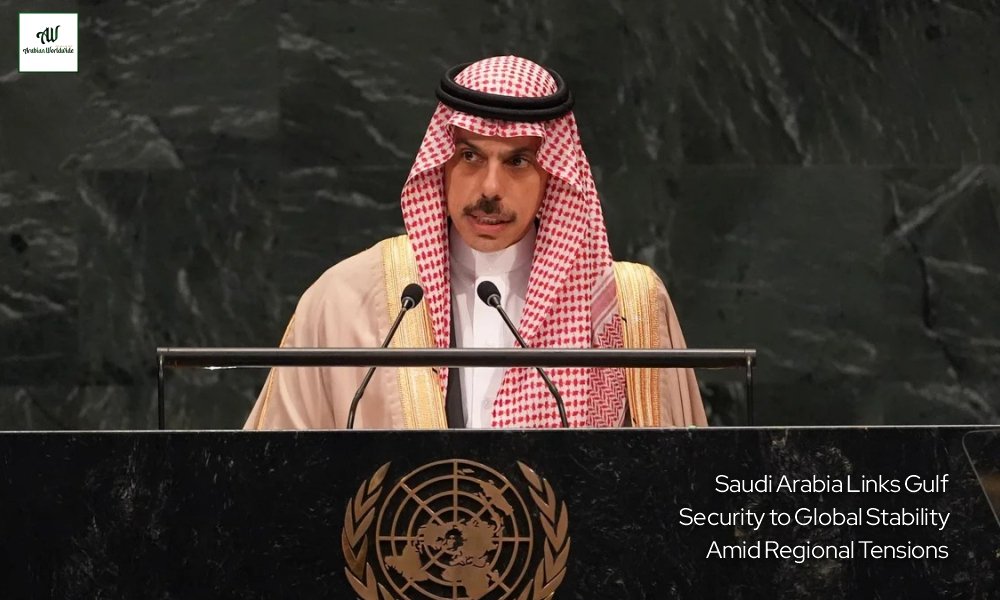
Saudi Arabia has warned that Gulf Security is closely tied to international peace, energy markets and global trade, as regional tensions continue to escalate.
Addressing the UN General Assembly, Saudi Foreign Minister Prince Faisal bin Farhan said Saudi Arabia and other countries in the region had faced what he described as “flagrant Iranian attacks” targeting security facilities, as well as civilian and economic infrastructure.
He reaffirmed Saudi Arabia’s right to protect its sovereignty, citizens, residents and national resources, while calling on the international community to address threats to global peace and security.
“The Gulf Security is part and parcel of the security of the region and the world at large,” he said.
Safeguarding Strategic Waterways
Prince Faisal said stability in the Gulf Security has direct implications for global energy security, international trade and supply chains. He called for freedom of navigation through key waterways, including the Strait of Hormuz, Bab el-Mandeb Strait, the Red Sea and the Gulf of Aden. He rejected the use of these routes as tools of pressure or threats and called for conditions in the Strait of Hormuz to return to those before February 28, without fees or restrictions.
At the same time, he backed diplomatic efforts by Qatar, Pakistan and others aimed at reducing tensions. He also called for comprehensive regional security arrangements that address the underlying causes of instability.
Gaza, Yemen and Regional Stability
On the Palestinian issue, Prince Faisal condemned attacks on civilians, restrictions on humanitarian aid, forced displacement and settlement expansion. He reiterated Saudi Arabia’s support for a two-State solution based on the 1967 borders, with East Jerusalem as the capital of an independent Palestinian state.
Regarding Yemen, he called for a comprehensive political settlement and highlighted Saudi Arabia’s provision of more than $29 billion in humanitarian and development assistance. He also condemned Houthi missile and drone attacks against Saudi Arabia and commercial shipping.
Energy Transition and Artificial Intelligence
Prince Faisal also highlighted Saudi Vision 2030 and called for energy security and climate action to advance together. He advocated practical energy transitions that include different energy sources, while pointing to Saudi investments in renewable energy, clean hydrogen, carbon capture and resilient infrastructure.
On artificial intelligence, he urged international cooperation focused on responsible development, ethics and capacity-building. He concluded that global challenges require collective action grounded in the UN Charter, international law and cooperation.
Also Read :- Saudi Arabia’s Red Sea Project Takes Shape as a New Luxury Destination