An innovative digital project is set to bring Egypt’s ancient pilgrimage city of Abu Mena back to life through augmented reality (AR), allowing visitors to explore its historic buildings, religious traditions and everyday activities.
The experience, whose launch date has not yet been announced, will be available through an interactive web page and at the visitor centre near the archaeological site. It aims to give visitors both on-site and remote access to a digital reconstruction of the once-thriving city.
Recreating a Historic Pilgrimage Centre
Abu Mena flourished between the fifth and seventh centuries around the tomb of Saint Menas, a Christian martyr associated with miracles and healing. The city attracted pilgrims from across the Mediterranean seeking blessings and cures. UNESCO added the archaeological site to its World Heritage List in 1979.
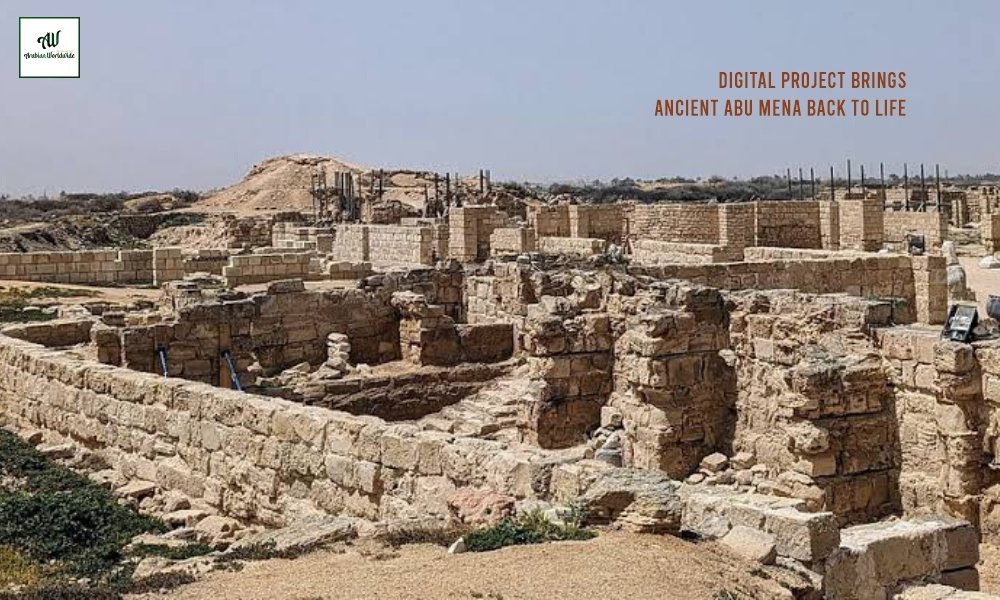
Its surviving remains include a baptistery, a tomb church housing the saint’s cave, a cruciform pilgrims’ church, accommodation facilities, public baths, workshops, pottery kilns, presses and water cisterns. A monastic community continues to live in the surrounding area.
According to the Ministry of Tourism and Antiquities, the Digital Project reconstruction draws on historical and archaeological documentation. Researchers have examined manuscripts, historical accounts, photographs and maps, alongside archival records preserved at the Greco-Roman and Coptic museums and the Supreme Council of Antiquities.
Blending Archaeology with Technology
Hussein Bassir, head of the Antiquities Museum at the Bibliotheca Alexandrina, described Abu Mena as more than an archaeological site, highlighting its importance as an international centre of Christian pilgrimage.
Speaking to The Gazette, Bassir said the project combines archaeological research, the human experience of pilgrimage and modern technology to help audiences visualise the city’s streets, churches and public facilities.
He emphasised that the reconstruction distinguishes between established evidence and interpretation. Foundations, walls, column bases and building layouts provide archaeological evidence, while building heights, roof designs, colours and decorations are inferred through comparisons with structures from the same period.
Everyday details, including market sounds, clothing, food and conversations, are imaginative elements rather than historically confirmed facts.
Bringing the Pilgrim’s Journey into Focus
Bassir noted that fifth-century pilgrims could have travelled from Alexandria and other Egyptian cities, as well as the Levant, Asia Minor and other Mediterranean regions. The digital experience aims to help modern audiences better understand the scale and significance of their journeys.
Also Read :- MENA Businesses Face Resilience Gap Amid Regional Challenges: Survey