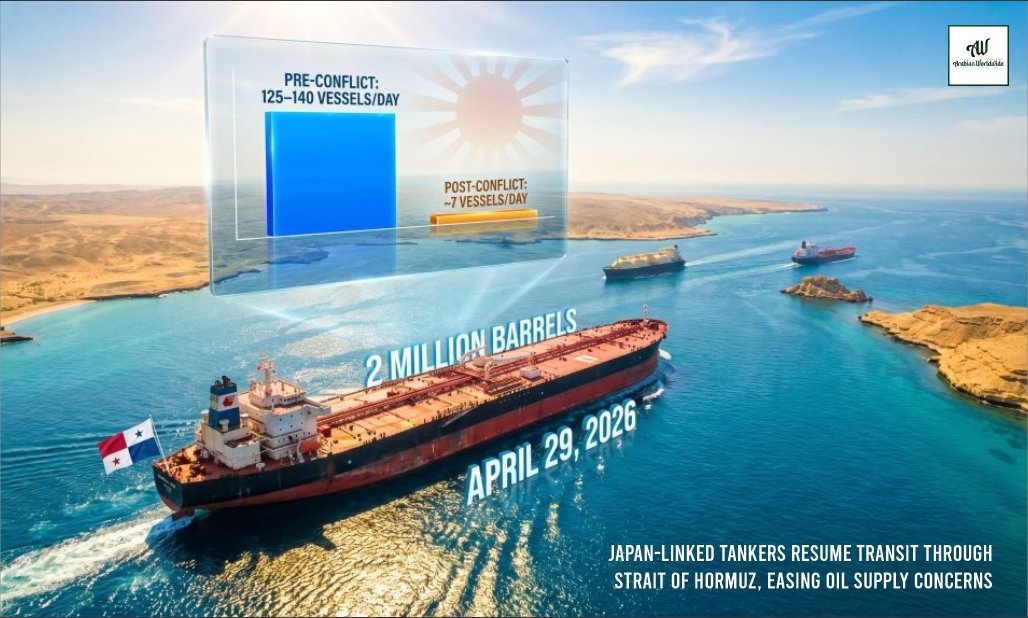
Two additional Japan-owned very large crude carriers (VLCCs) carrying Saudi Arabian crude have begun transiting the Strait of Hormuz, marking another step toward easing the backlog of oil shipments that had remained stranded in the Gulf. According to shipping data from LSEG and Kpler, the vessels were en route on Tuesday, joining several Japan-linked ships that resumed their voyages a day earlier.
The latest departures underscore a gradual normalization of crude exports from one of the world’s most strategically important maritime routes, following recent disruptions that had raised concerns over global energy supplies.
Strait of Hormuz Japan-Linked Fleet Carries 16 Million Barrels
The two VLCCs are owned and managed by Japanese shipping giants Nippon Yusen KK (NYK Line) and Kawasaki Kisen Kaisha (K Line). Data from Kpler indicates that each vessel loaded approximately 2 million barrels of Saudi Arabian crude on March 1, bringing the total crude volume aboard Japan-linked tankers exiting the Strait of Hormuz this week to 16 million barrels. The shipping companies did not immediately respond to requests for comment regarding the latest voyages.
The movement of these vessels significantly reduces the quantity of crude that had remained stranded inside the Gulf, offering relief to energy markets that closely monitor shipping activity through the narrow waterway.
Earlier Convoy Signals Resumption of Trade
The latest departures follow Monday’s movement of a larger convoy of Japan-linked vessels through the Strait of Hormuz. That group included six very large crude carriers transporting around 12 million barrels of Middle Eastern crude, along with two chemical tankers, a vehicle carrier, and a container ship.
The crude cargoes originated from Saudi Arabia, the United Arab Emirates, and Qatar, having been loaded between late February and early March before shipment delays disrupted their onward journey.
Strategic Waterway Remains Under Global Watch
The Strait of Hormuz remains one of the world’s busiest and most strategically significant energy corridors, serving as a vital gateway for crude exports from Gulf producers to international markets. Any disruption to shipping through the strait has immediate implications for global oil supplies, freight rates, and energy prices.
The steady departure of Japan-linked vessels this week suggests that previously delayed shipments are gradually clearing, helping restore the flow of Middle Eastern crude to key Asian markets. While industry participants continue to monitor developments closely, the resumption of tanker movements offers a positive signal for global energy logistics and supply chain stability.
Also Read :- Dubai Customs Strengthens Global Trade Through Strategic Logistics Partnership